Red Light Therapy Devices: Which Type Actually Makes Sense for You?

Shopping for red light therapy devices gets confusing pretty quickly.
One device fits in your hand. Another sits on a table. Another is almost as tall as you are. Then there are wavelengths, irradiance numbers, treatment distances, LEDs, timers, and enough specifications to make you wonder whether you accidentally started shopping for laboratory equipment.
It does not need to be that complicated.
The best red light therapy device is not automatically the biggest, most powerful, or most expensive one. It is the device that covers the area you actually want to treat and makes enough sense for your routine that you will consistently use it.
That is where we would start.
First, What Is a Red Light Therapy Device Actually Doing?
Red light therapy, also called photobiomodulation or PBM, exposes tissue to specific wavelengths of red and near-infrared light.
Researchers are still working through all of the mechanisms involved, but one of the major theories involves light interacting with cellular processes associated with mitochondria and cytochrome c oxidase. These interactions can affect mitochondrial signaling and cellular responses. You can get considerably deeper into the biology in this review of photobiomodulation mechanisms.
And this is not UV radiation.
A 2025 evidence-based clinical consensus concluded that PBM has a favorable safety profile for adults and that red-light PBM does not induce DNA damage.
The device's job is basically to deliver the right kind of light to the area you want to expose.
The question is how much area that needs to be.

Handheld Red Light Therapy Devices
Handhelds make sense when your goal is specific.
Maybe you primarily want to use red light on your face. Maybe it is your knee, shoulder, elbow, or another small area. There is little reason to illuminate half the room if you only want to treat one spot.
That is exactly where a device like the Vital Charge fits into the Vital lineup.
It is a small rechargeable handheld unit designed for targeted treatment. Vital currently equips it with red and near-infrared wavelengths and a 10-minute timer. Because it is portable, you also are not permanently dedicating a corner of your house to red light therapy.
The tradeoff is obvious: coverage.
Treating a small area with a handheld is convenient. Trying to cover your back, legs, abdomen, and chest one tiny section at a time gets old fast.
That brings us to panels.
Mid-Sized Panels: The Middle Ground
For a lot of people, a mid-sized red light therapy device is the sweet spot.
You get considerably more coverage than a handheld without moving into a large full-body setup.
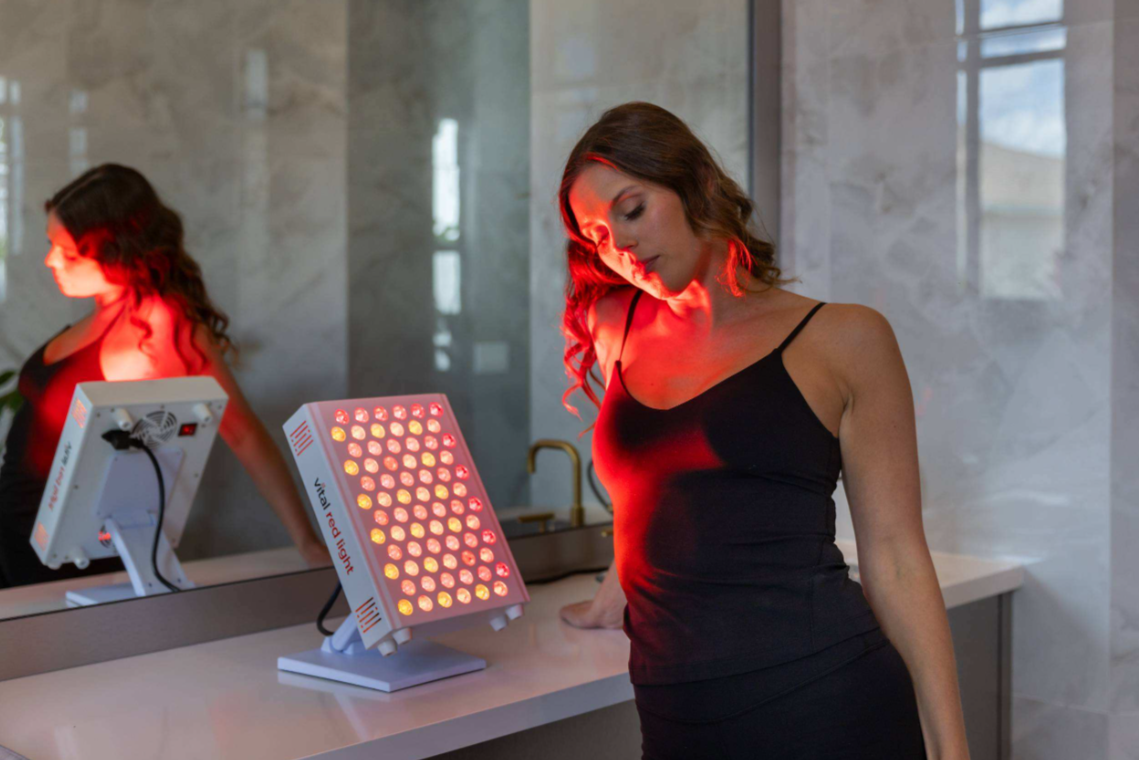
The Vital Pro is Vital Red Light's targeted panel, while the newer Vital Pro 2.0 expands the concept with nine wavelengths and preset treatment options.
This kind of device makes sense if your goals are mixed.
You may want to use it on your face one day, your upper body another day, and your legs after a workout. You can reposition the panel rather than buying separate equipment for every body part.
For someone entering red light therapy who wants versatility, that is a pretty practical setup.
Full-Body Red Light Therapy Devices
Then there are the big ones.
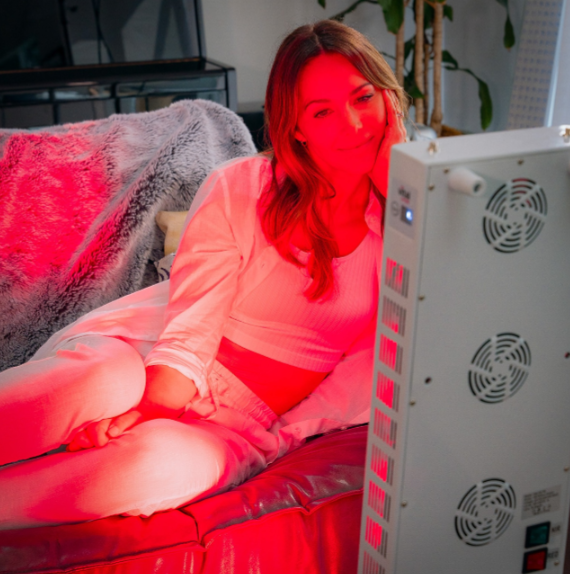
A full-body panel is less about changing what red light is and more about changing how much of you can be exposed at once.
Vital's Vital Elite is designed for full-body treatment and uses 630 and 660 nm red light alongside 830 and 850 nm near-infrared light. The larger Vital Elite 2.0 expands the wavelength selection to nine.
Why go bigger?
Convenience and coverage.
If your routine involves your legs, back, abdomen, shoulders, and other large areas, treating each individually can turn a simple wellness routine into a small part-time job.
A larger panel lets you expose substantially more surface area during one session.
That is especially attractive for people whose goals are not limited to one troublesome knee or one area of skin.
More Power Is Not Automatically Better
This is one specification worth understanding before buying anything.
It is tempting to compare red light therapy devices by irradiance and simply choose the highest number.
PBM does not necessarily work that way.
Research has repeatedly described a biphasic dose response, meaning biological responses can vary depending on how much light is delivered. Too little may not produce the desired response, while simply increasing exposure indefinitely does not necessarily improve it. This phenomenon is discussed extensively in the scientific literature on PBM dosing.
So the goal is not to roast yourself under the most powerful panel you can find.
Wavelength, irradiance, distance, exposure time, and treatment area all matter.
That is one reason Vital provides treatment guidelines rather than treating maximum power like a scoreboard.
Red Light Versus Near-Infrared Light
Another useful feature to check is wavelength.
Red and near-infrared light are not identical.
Red wavelengths are generally associated with more superficial tissue exposure, while near-infrared wavelengths penetrate more deeply. PBM research uses a range of wavelengths depending on the tissue and outcome being investigated.
This is why Vital combines red and near-infrared wavelengths across its core red light therapy devices instead of making you choose one or the other.
The newer Pro 2.0 and Elite 2.0 broaden that spectrum even further, but more wavelengths do not automatically mean everyone needs the most advanced model.
If your needs are straightforward, a simpler device may be plenty.

So Which Vital Red Light Device Should You Choose?
Make the decision based on how you see yourself actually using it.
If you want portability and mostly targeted treatment, the Vital Charge makes sense.
If you want greater coverage without committing to a full-body panel, look at the Vital Pro or Pro 2.0.
If you know from the beginning that you want large-area or full-body sessions, the Vital Elite line eliminates a lot of repositioning.
There is no prize for buying more device than you need.
There is also not much value in buying a tiny device and discovering two weeks later that you are tired of moving it around your entire body.
The right red light therapy device should make treatment easier, not become another piece of wellness equipment collecting dust next to the treadmill.
Ready to Find Your Red Light Therapy Device?
Vital Red Light offers handheld, targeted, and full-body red light therapy devices so you can choose based on how you actually plan to use red light therapy.
Vital devices are third-party independently tested, and the current consumer lineup includes a three-year warranty and 30-day risk-free trial. You can compare Vital Red Light devices and find the right size for your routine here.
Share