


You Have Three Days. Your Body Would Like One of Them. Take Advantage of Vital Red Light's Labor Day Sale
It’s Labor Day weekend. Your inbox can wait. The laundry can probably wait. And whatever you convinced yourself absolutely needs to get done before Tuesday? There’s a decent chance that can wait too.
You have three days. We’re asking for 10 to 20 minutes of them.
Preferably while doing absolutely nothing.
Get your red light on.
Because if there were ever a weekend to sit there, soak up some red light and call it part of your wellness routine, this would be it.
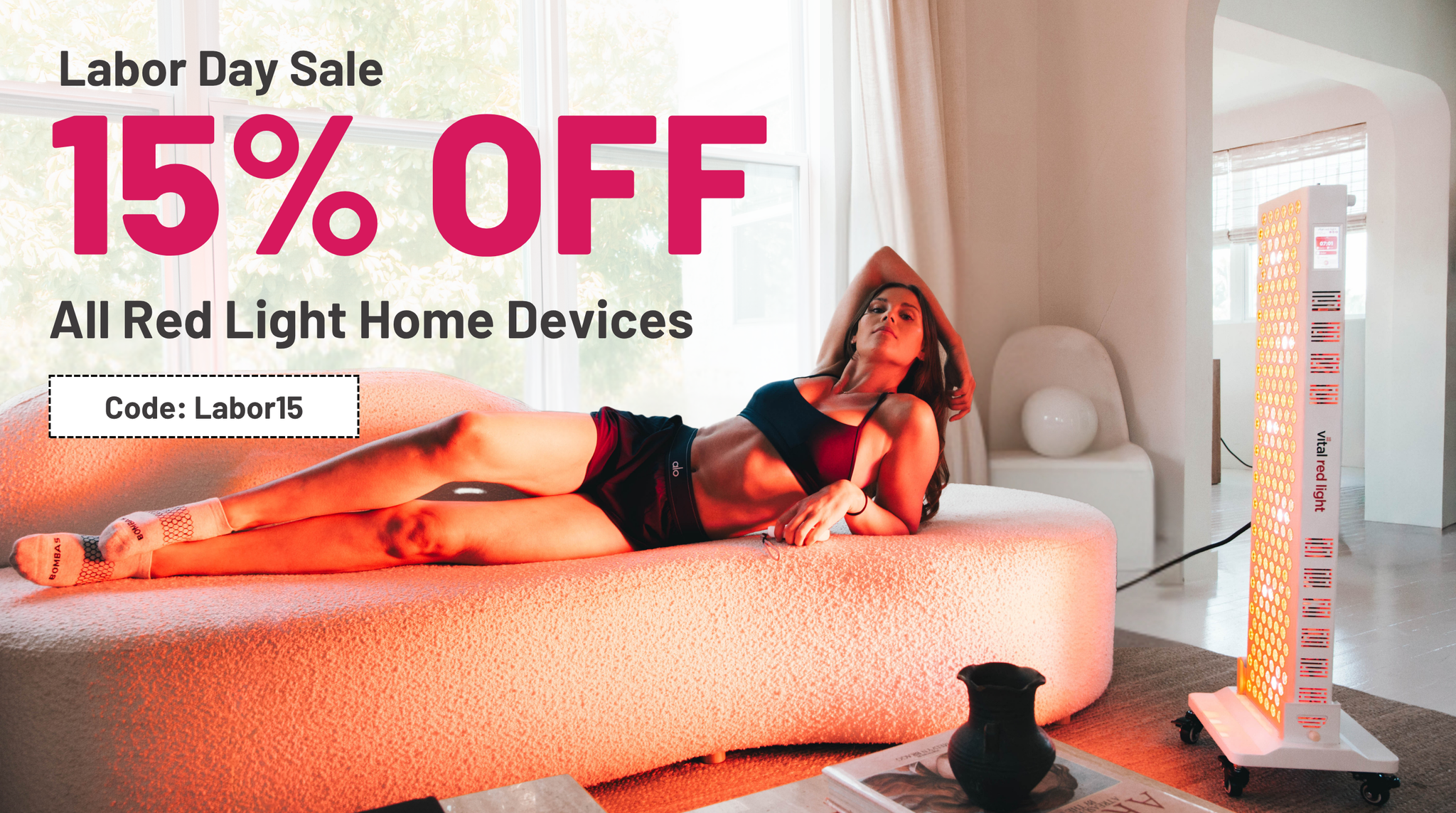
And since we’re already making things easier for you, Vital Red Light is giving you 15% off your red light therapy device this Labor Day with code LABOR15.
But before you decide which part of your three-day weekend you're dedicating to doing absolutely nothing, keep reading. We’re getting into what red light therapy is actually doing during those 10 to 20 minutes, how it may support your skin, sleep and recovery, and why a little intentional downtime might be exactly what your Labor Day weekend has been missing.
Somehow, We Turned a Three-Day Weekend Into Three Days of Catching Up
Be honest. How many things have you already decided you're going to accomplish this weekend?
There's the cleaning you've been putting off. The errands you haven't had time to run. The workout you promised yourself you'd get in. The barbecue. The family plans. The friends you haven't seen in a while.
Suddenly, your three-day weekend has a schedule.
And somehow Monday night arrives and you need a break from your break.
We're not telling you to cancel your plans and spend Labor Day lying completely motionless in a dark room. That would be a little dramatic.
We are saying that doing something for yourself doesn't always have to mean doing more.
Sometimes it can mean setting aside 10 to 20 minutes, sitting in front of your red light therapy device and allowing yourself to stay there without simultaneously trying to accomplish six other things.
Because even though it may look like you're just sitting in front of a bunch of very red LEDs, there's more going on than that.

So, What Are You Actually Doing During Those 10 to 20 Minutes?
This is where we have to get slightly scientific.
Don't worry. Slightly.
Red light therapy, also called photobiomodulation, uses red or near-infrared light. Those photons can interact with photoreceptors within the body, with one of the commonly discussed mechanisms involving cytochrome c oxidase in the mitochondria.
Yes, the mitochondria.
We're taking you back to biology class for approximately 30 seconds.
You probably remember being told that mitochondria are the “powerhouses of the cell.” That's because they're involved in producing ATP, which cells use for energy.
Research into the mechanisms of photobiomodulation has examined effects involving mitochondrial activity and cellular signaling.
So, from your perspective?
You're sitting there.
From your cells' perspective?
There's considerably more to the story.
And that's part of what makes red light therapy so easy to work into a Labor Day weekend. You don't need to turn those 10 to 20 minutes into another activity you're trying to perfect.
Position yourself correctly. Turn the device on. Follow your treatment instructions.
That's enough.
Your Sleep Schedule Might Appreciate Some Attention Too
Three-day weekends have a funny relationship with sleep.
Friday night becomes Saturday morning. You sleep later because you can. Sunday night doesn't really feel like Sunday night because Monday isn't a workday.
And then Monday night comes around.
Suddenly, tomorrow is Tuesday, your alarm is set again and you're wondering what happened.
Photobiomodulation is now being studied for its potential relationship with sleep quality too.
A 2026 systematic review and meta-analysis looked at five randomized controlled trials involving 240 participants. Overall, photobiomodulation was associated with improved sleep-quality scores compared with sham treatment.
That's interesting.
It is not, however, permission for us to tell you that turning on your Vital Red Light device tonight guarantees the best sleep of your life.
The researchers themselves noted that the evidence is still limited, the estimate lacked precision and more standardized research is needed.
That's how wellness research works sometimes. We learn something promising, researchers keep investigating it, and we don't turn “promising” into “proven miracle” somewhere between the study and Instagram.
So while red light therapy isn't replacing a consistent bedtime, a comfortable sleeping environment or all the other things that contribute to good sleep, its potential role in sleep is another area researchers are actively exploring.
In the meantime, spending a few quiet minutes away from everything else probably isn't the worst addition to your Labor Day evening routine.
If Your Idea of Resting Still Includes a Workout, We See You
Some people hear “three-day weekend” and think couch.
Other people hear it and immediately start planning a workout.
We know who you are.
Maybe it's the gym. Maybe you're going for a run. Maybe someone convinced you that pickleball at 10 a.m. on Labor Day sounded relaxing until you discovered they're alarmingly competitive.
Whatever you're doing, photobiomodulation has also been studied in relation to exercise performance, muscle soreness and recovery.
A 2025 systematic review and meta-analysis involving 19 studies and 672 participants found low-certainty evidence that photobiomodulation applied before exercise reduced subsequent muscle soreness. Other recent research on delayed-onset muscle soreness has also reported encouraging results at certain post-exercise time points.
There's an important catch, though.
These studies use particular wavelengths, doses, treatment locations and timing. Research involving localized photobiomodulation also shouldn't automatically be treated as proof that every full-body device and protocol will produce an identical result.
Basically, we're not going to tell you that sitting in front of a red light after one brutal Labor Day workout makes soreness disappear.
We are going to tell you that exercise recovery is one of the areas scientists continue to investigate with photobiomodulation, and the research gives us good reason to keep paying attention.
So if your version of “taking it easy” somehow includes working out anyway, your red light routine doesn't necessarily have to take the weekend off with the rest of us.
And Yes, Your Skin Can Get Some Attention Too
Maybe muscle recovery isn't why you're interested in red light therapy at all.
Maybe you're here for your skin.
Fair.
Red and near-infrared photobiomodulation have received considerable attention in dermatology, including research into applications involving skin aging and other dermatologic concerns. The American Academy of Dermatology notes that red light is used for skin concerns including signs of aging, although results and evidence vary depending on the particular use.
And this is where we come back to the whole point of this Labor Day conversation.
Self-care doesn't have to become another appointment.
You don't necessarily need to leave your house, drive somewhere, wait around, have your treatment and drive home.
With an at-home Vital Red Light device, your red light session happens where you already are.
Which, on Labor Day weekend, is hopefully somewhere comfortable.
Your Labor Day Red Light Routine Can Be Extremely Uneventful
We have a tendency to make wellness complicated.
There has to be a routine.
And a tracker.
And an app.
And twelve steps that someone on TikTok swears completely changed their life.
Your Labor Day red light routine doesn't need any of that.
Step one: Get comfortable.
Step two: Position yourself at the recommended treatment distance for your device.
Step three: Turn your red light on.
Step four: Sit there.
That's pretty much the exciting part.
Read something. Listen to music. Close your eyes for a few minutes. Think about absolutely nothing. Think about everything. We aren't here to police your thoughts.
What we do want you to remember is that more isn't automatically better.
Red light therapy involves dose. Treatment distance, irradiance, wavelength and exposure time all influence how much light reaches the treatment area.
So if the instructions call for a particular treatment time, don't decide that tripling it must mean tripling the benefits.
Your goal isn't to see how long you can sit in front of the light.
It's to use it appropriately and consistently.

Pick the Kind of Doing Nothing That Works for You
Of course, “doing nothing” looks a little different depending on where you're spending Labor Day.
Maybe you're home all weekend.
Maybe you're traveling.
Maybe your plans involve spending as little time indoors as humanly possible.
That's why Vital Red Light doesn't make one device and expect it to make sense for everybody.
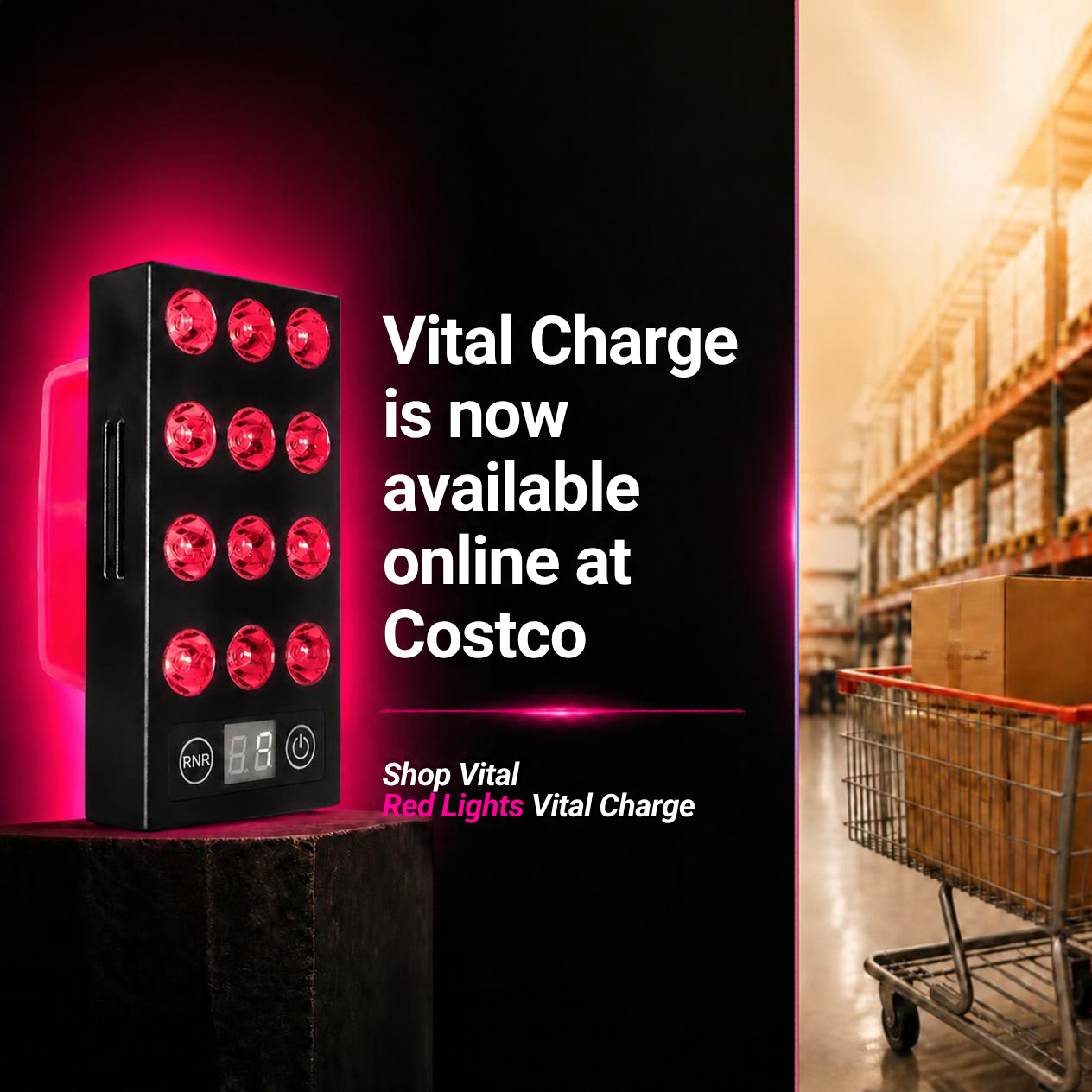
The Vital Charge is the portable option. If Labor Day has you traveling or moving around, it gives you targeted red and near-infrared light without requiring you to bring a full-size panel along for the ride.
For someone who wants broader coverage at home, the Vital Pro and Vital Pro 2.0 step things up with larger treatment areas and more comprehensive setups.
Then there are the Vital Elite and Vital Elite 2.0 for people looking for even greater coverage and a more substantial at-home red light therapy setup.
Different devices. Different routines.
Same general idea: your red light therapy shouldn't require rearranging your entire life to use it.
And right now, every one comes with a particularly nice Labor Day bonus.
Labor Day Is the Excuse. Tuesday Is the Real Point.
We'd love to tell you that after this three-day weekend, life suddenly becomes calm and perfectly manageable.
Unfortunately, Tuesday exists.
The emails come back.
The meetings come back.
The errands you successfully ignored all weekend are still sitting there waiting for you.
That's when having your wellness routine at home starts making even more sense.
You don't need to schedule another appointment.
You don't need to drive anywhere.
You don't need to turn a 10-to-20-minute red light session into a two-hour event.
You need a little bit of time and your device.
That's why Labor Day isn't really the most important part of this.
It's simply a good opportunity to start.
Take 15% Off Vital Red Light This Labor Day
If you've been waiting for an excuse to bring red light therapy home, we'll happily give you one.
For Labor Day, Vital Red Light is offering 15% off red light therapy devices with code LABOR15.
Choose the device that makes sense for your routine. Give yourself those 10 to 20 minutes. Use it consistently and according to the recommended directions.
Then go enjoy your day off.
You can be productive again on Tuesday.
Your inbox will still be there when you get back.
Unfortunately.

Frequently Asked Questions
How long should a red light therapy session last?
Treatment time depends on the device, treatment distance, irradiance and intended dose, so there isn't one universal session length for every red light therapy product. Users should follow the directions provided for their specific device rather than assuming that longer exposure automatically produces better results.
Can I use red light therapy every day?
How frequently red light therapy should be used depends on the device, treatment protocol and individual circumstances. Follow the recommended schedule for the particular Vital Red Light device rather than increasing frequency simply because the treatment is noninvasive.
Should I use red light therapy before or after a workout?
Both timing and treatment protocol matter. Some research on muscle recovery has found benefits when photobiomodulation was applied before exercise, while other studies have investigated post-exercise treatment. Those findings are protocol-specific, so they shouldn't be interpreted as one universal rule for every red light therapy device or workout.
Can red light therapy help with sleep?
There is emerging research on photobiomodulation and sleep. A 2026 systematic review and meta-analysis of five randomized controlled trials found an improvement in sleep-quality scores compared with sham treatment, but the researchers emphasized that the evidence remains limited. More research is needed before drawing firm conclusions.
How close should I sit to a red light therapy device?
The appropriate treatment distance depends on the device because distance changes the amount of light reaching the treatment area. Follow the recommended treatment distance for your specific Vital Red Light product instead of assuming that getting as close as possible is better.
Which Vital Red Light device is right for me?
Start with how you actually plan to use it. Someone who prioritizes portability and targeted treatments may prefer the Vital Charge, while the Vital Pro and Vital Pro 2.0 provide greater coverage for at-home sessions. The Vital Elite and Elite 2.0 are designed for people looking for an even larger treatment setup. The best option is the one whose coverage and format fit realistically into your routine.
Share


See More Blog Posts
Explore Red Light Devices


General
- Home
- Shop
- Reviews
- Blog
- Red Light for Business
- Vital App
- Contact Us
Learn
- About us
- How it works?
- Third Party Testing & Certification
- Benefits
- Vs. Competition
- Discount Code
- Military & First Responder Discount
Help
- FAQ
- Wholesale
- Returns
- Warranty
- Affiliates
- Financing
- HSA/FSA
Contact
- support@
vitalredlight .com - (844) 848-2575
- 474 SW 12th Ave,
Deerfield Beach, FL, 33442
Follow Us


Sign Up for our Emails

© 2025–2026 Vital RLT LLC. Part of the Paradox Brands family.