Red Light Therapy Dosage: How Many Joules, Minutes, and What Distance Do You Actually Need?
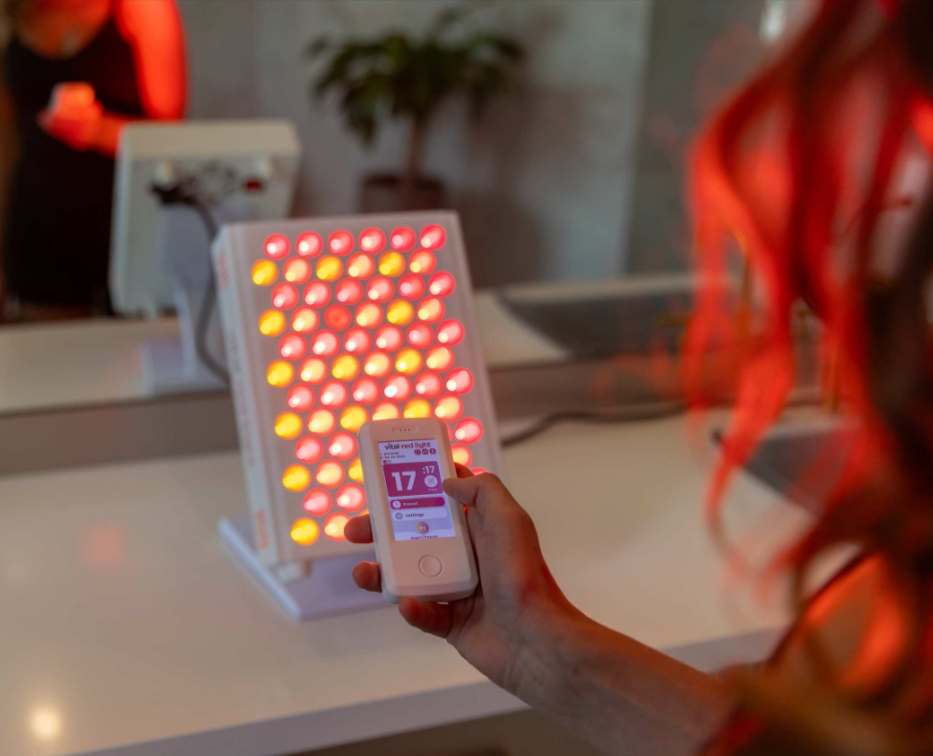
You bought a red light therapy device, found the perfect place for it, and are now probably wondering how long you are supposed to stand in front of the thing.
Ten minutes sounds reasonable. Twenty minutes should work twice as well. Move closer, and maybe you can get it done faster?
Not quite.
When it comes to red light therapy, minutes are only part of the equation. The amount of light reaching your body, how far you are from the device, which wavelengths you're using, what you're trying to accomplish, and even how quickly that energy is delivered can all matter.
This is where red light therapy dosage gets confusing, because there isn't a single magic number of joules or a perfect treatment time that works for everyone. In fact, a major review of Photobiomodulation (PBM) research found that there is still no universally agreed-upon set of treatment parameters.
So, we're not going to make one up.
Instead, we're going to show you what those numbers on your red light therapy device actually mean, how dosage is calculated, what research has used, and why 10 minutes in front of one panel may be very different from 10 minutes in front of another.

What Does Red Light Therapy Dosage Actually Mean?
If you've ever looked into red light therapy dosage and immediately found yourself surrounded by J/cm², mW/cm², and fluence, you're in good company. It sounds much more complicated than it really is.
Let's simplify this a bit.
There are three numbers you really need to understand:
-
Irradiance tells you how much light power is reaching a given area. It's commonly expressed in milliwatts per square centimeter, or mW/cm².
-
Time is how long that light is being delivered.
-
Fluence, often called energy density or dose, tells you how much energy was delivered over that area during the treatment. It's measured in joules per square centimeter, or J/cm².
Think about filling a glass with water.
Irradiance is how fast the water is coming out of the faucet. Treatment time is how long you leave the faucet running. Your final dose is how much water you ended up with.
That's why saying, "I use red light therapy for 10 minutes," doesn't actually tell us very much.
We need to know how fast that faucet was running.
How to Calculate Your Red Light Therapy Dose
Here is the basic calculation:
Dose (J/cm²) = Irradiance (mW/cm²) × Time (seconds) ÷ 1,000
Let's say your skin is receiving an irradiance of 50 mW/cm² and you're exposed to it for two minutes.
Two minutes is 120 seconds.
50 × 120 ÷ 1,000 = 6 J/cm².
So, your estimated surface dose would be 6 J/cm².
Now let's make it more interesting.
Say you're receiving 100 mW/cm² for five minutes:
100 × 300 ÷ 1,000 = 30 J/cm².
But if you're receiving only 20 mW/cm² for those exact same five minutes:
20 × 300 ÷ 1,000 = 6 J/cm².
Same five-minute red light therapy session. Very different amount of energy delivered at the surface.
This relationship between irradiance and exposure time is well established in PBM dosimetry. It's also why we don't love telling someone to "just use it for 10 minutes" without talking about the device they're actually using.
So, How Many Joules of Red Light Therapy Do You Actually Need?
Here's where we'd love to give you one number to remember.
We can't.
Or, more accurately, we could, but we'd be oversimplifying the science to make the answer prettier.
Researchers have used wildly different red light therapy doses depending on the wavelength, tissue, condition, light source, irradiance and desired outcome. One comprehensive review of treatment parameters noted recommendations ranging from approximately 4 to 10 J/cm² at the target tissue in some applications, while other recommendations reach as high as 50 J/cm² at the tissue surface.
That's a pretty large difference.
The same review also found that there is no fixed dose that consistently produces a positive effect across every application.
That's because asking, "How many joules of red light therapy do I need?" is a little like asking, "How many pounds should I lift?"
For what?
A biceps curl? A deadlift? Physical therapy after an injury?
The number means very little until we know what we're trying to accomplish.
With red light therapy, the better questions are:
What tissue are we targeting?
Which wavelengths are being used?
How much light is reaching the skin?
How deep is the target?
How long is each treatment?
How often are treatments repeated?
Now we can actually have a useful conversation.
Skin, Hair, Muscles and Joints Don't All Have the Same Dosage Needs
This is one of the reasons we're cautious when we see universal red light therapy dosage charts online.
Your face and your quadriceps are not the same target.
Neither are your scalp and your knee.
Modern photobiomodulation uses red and near-infrared wavelengths, with red generally referring to roughly 620–700 nm and near-infrared extending beyond the visible red spectrum. A 2024 dermatology review explains that these wavelengths interact with cellular photoreceptors and can influence mitochondrial and downstream cellular processes.
But wavelength is only one part of treatment.
A facial rejuvenation trial, for example, used 660 nm red LEDs at 6.4 mW/cm² for 21-minute sessions, producing an exposure of approximately 8.02 J/cm². Participants were treated two or three times per week for four weeks. You can see the full treatment parameters in the study.
That's useful information.
It does not mean 8.02 J/cm² is now the official dose for your face.
It's one protocol using a particular wavelength, irradiance, device, schedule and treatment goal.
This is exactly how we want you to look at red light therapy studies. Don't grab the joule number and leave everything else behind.
The Dose at Your Skin Isn't Necessarily the Dose Reaching Your Target
Here's another wrinkle that gets skipped a lot.
Let's say you've calculated that your red light therapy panel is delivering 10 J/cm² at the surface of your skin.
If you're targeting the skin itself, that surface measurement is especially relevant.
But what if you're interested in a muscle, tendon or another structure underneath it?
You cannot assume that deeper tissue is receiving the same 10 J/cm².
Light can be absorbed, reflected and scattered as it travels through tissue. Red and near-infrared light were partly adopted for photobiomodulation because their optical properties allow useful tissue penetration compared with many other wavelengths, but penetration is certainly not 100%. The mechanistic literature discusses these tissue interactions in much greater detail.
So when your device's irradiance and your calculator tell you that you received 10 J/cm², what you've calculated is an estimated surface exposure.
You haven't somehow measured the exact number of joules that reached your hamstring.
That distinction matters.
How Distance Changes Red Light Therapy Dosage
Now we get to one of the biggest practical questions: How far should you stand from a red light therapy panel?
Distance matters because it changes how much light reaches you and how that light is distributed across your body.
Generally, moving closer to a panel means greater irradiance. Moving farther away reduces irradiance but may improve coverage and uniformity across a larger area.
So why not just get as close as possible?
Because, again, more isn't automatically better.
There's also a little physics misconception we should clear up.
You may have seen online calculators use the inverse-square law to predict exactly how much irradiance falls as you move away from a red light therapy device.
The inverse-square law works nicely for an ideal point source.
Your big LED panel is not an ideal point source.
It has dozens or hundreds of individual LEDs. Those LEDs have optics and beam angles, and their beams overlap differently as distance changes.
So rather than trying to calculate the irradiance at 12 inches based on a measurement taken at six inches, we would much rather see a manufacturer actually measure its output at the treatment distance you're going to use.
That gives you information you can actually work with.
Six Inches, 12 Inches or 18 Inches: What's Better?
None of those distances is automatically best.
Closer usually means:
- Higher irradiance
- A potentially smaller treatment footprint
- Less time required to reach a given surface energy exposure
Farther away usually means:
- Lower irradiance
- Broader coverage
- More overlap between LED beams
- More time required to reach the same calculated surface exposure
This is one of the reasons Vital Red Light designs its larger panels for practical treatment distances rather than asking you to practically hug the device.
For example, the Vital Pro 2.0 and Vital Elite 2.0 are designed around 10-minute treatments from approximately one to two feet away. They also use nine wavelengths across blue, yellow, red and near-infrared light rather than building the entire device around one or two wavelengths.
That matters to us because a useful red light therapy device isn't the one that wins a spec-sheet contest from an inch away. It's the one that can deliver useful light across the area you're actually trying to treat, at a distance you're actually going to use, in a routine you're actually going to stick with.
Why Irradiance Numbers Can Be Misleading
This is where shopping for red light therapy can get a little...creative.
You'll see:
200 mW/cm²!
300 mW/cm²!
Ultra high-powered!
Lovely. At what distance?
Was that the highest reading anywhere in front of the device or an average across the treatment area?
Were all wavelengths running?
Where was it measured?
What meter was used?
Was it measured directly against the LEDs?
Because those details can dramatically change what the number means.
Researchers have pointed out that PBM studies need proper measurement, reporting and device characterization precisely because treatment results become difficult to reproduce when these variables aren't clearly reported. A WALT position paper goes even further, noting that discrepancies can exist between manufacturer specifications and actual device performance.
That's why we think the industry's obsession with chasing the largest possible irradiance number misses the point.
Vital Red Light panels are designed around treatment as a whole: multiple optimized wavelengths, usable treatment distances, broad coverage, timer controls and output meant for practical at-home sessions. That's a much more useful way to evaluate a device than picking whichever product has the biggest number in bold print.
Because your mitochondria, unfortunately, do not read marketing materials.
More Powerful Red Light Therapy Isn't Automatically Better
This may be the most important thing in this entire guide.
Red light therapy does not appear to follow a simple relationship where:
More light = more benefit.
PBM research has repeatedly described what is called a biphasic dose-response.
You can picture it like an upside-down U.
At a very low exposure, there may not be enough stimulus to produce the desired biological response.
Increase the exposure and you may move into a more effective range.
Keep increasing it and, eventually, the effect may plateau or even decrease.
This phenomenon has been documented across PBM research, although the location of that ideal window depends on the biological target and treatment parameters.
That's important.
We're not saying there's one magic point where every person suddenly gets "too much" red light therapy.
There isn't.
We're saying the evidence doesn't support assuming that doubling your dose will double your result.
So if your device says 10 minutes, doing 40 minutes because you're feeling ambitious isn't necessarily a clever shortcut.
Can You Overdo Red Light Therapy?
You can certainly deliver more light than necessary.
That doesn't mean "overdose" in the way we talk about medication. But excessive exposure is not the goal of photobiomodulation.
Researchers have intentionally tested very high doses of LED red light on human skin to study safety. In two dose-escalation trials, investigators tested fluences far beyond what you'd typically associate with a normal consumer session.
Those studies are useful for understanding safety.
They are not instructions for your Tuesday-night skincare routine.
That's an important difference.
A dose being tolerated does not make it optimal.
This is why red light therapy should be approached as finding an effective treatment window, not collecting as many joules as possible.

Does 10 J/cm² Delivered Slowly Equal 10 J/cm² Delivered Quickly?
Now you're officially getting good at this.
Mathematically, yes.
Biologically, not necessarily.
Imagine one treatment delivers:
10 mW/cm² for 1,000 seconds.
That's 10 J/cm².
Another delivers:
100 mW/cm² for 100 seconds.
Also 10 J/cm².
If energy density were the only variable that mattered, we'd expect those treatments to be interchangeable.
PBM research suggests they may not be.
A recent dosimetry overview explains that lower irradiance delivered for longer can sometimes produce different therapeutic effects than higher irradiance delivered over a shorter period, even when the final calculated J/cm² is identical.
An extensive parameter review reached a similar conclusion: irradiance, fluence, wavelength, treatment duration and target tissue all have to be considered together.
So the equation is extremely useful.
It just isn't the entire biology lesson.
Does Wavelength Change the Dose You Need?
Yes, which is another reason you shouldn't take a dosage from one study and automatically apply it to another red light therapy device.
Wavelength affects how light interacts with tissue.
The PBM literature commonly studies red and near-infrared wavelengths because of their interaction with cellular photoreceptors and their ability to penetrate tissue to different degrees. The Journal of the American Academy of Dermatology describes PBM as generally involving red wavelengths from 620–700 nm and near-infrared wavelengths from 700–1440 nm.
Different wavelengths aren't simply interchangeable because they all happen to come out of an LED.
This is one of the reasons Vital Red Light moved beyond the standard 660 nm + 850 nm combination found in so many consumer panels.
The Vital Pro 2.0 and Vital Elite 2.0 incorporate nine wavelengths: 480, 590, 630, 660, 670, 810, 830, 850 and 1060 nm.
That gives you a much broader spectrum in one system rather than forcing one wavelength pair to handle every treatment goal.
Still, even with more wavelength options, dosage matters. A better spectrum doesn't give us permission to ignore irradiance, distance and treatment time.
Everything works together.
How Often Should You Use Red Light Therapy?
There's another part of dosage we haven't talked about yet.
Frequency.
A red light therapy protocol isn't just:
10 J/cm². Done.
It's more like:
X J/cm² per treatment × X treatments per week × X weeks.
Clinical PBM protocols vary considerably.
For musculoskeletal applications, for example, the World Association for Photobiomodulation Therapy publishes condition- and wavelength-specific dosage recommendations rather than one universal treatment schedule.
Other clinical applications use completely different schedules.
That tells us something important.
The question isn't only:
"How much light should I use?"
It's:
"How much per session, how often, and for how long?"
For home users, the safest practical starting point is the treatment protocol provided for the device you're actually using rather than trying to reverse-engineer a clinical laser study you found online.
How to Calculate Your Red Light Therapy Session
Okay, enough physics. Let's make this useful.
If you want to understand the dosage from your red light therapy device, here's the process.
Step 1: Decide What You're Actually Targeting
Skin?
Scalp?
Muscles?
Joints?
General full-body use?
Don't start with a joule number. Start with the goal.
Step 2: Know Your Wavelengths
Find out which wavelengths your device is actually delivering.
Red and near-infrared wavelengths aren't interchangeable, and neither are protocols that use them.
Step 3: Find the Irradiance at Your Treatment Distance
This is a big one.
Don't use the highest irradiance number you can find on the product page if that number was measured at a completely different distance.
You want the irradiance where your body actually is.
Step 4: Look at the Evidence for Your Goal
If you're trying to understand research-backed dosing, look for studies involving the same or similar target, wavelengths and treatment approach.
Don't copy one number from the abstract and call it a day.
Step 5: Calculate Your Estimated Surface Dose
Remember:
J/cm² = mW/cm² × seconds ÷ 1,000
That's your estimated energy exposure at the surface where irradiance was measured.
Step 6: Don't Ignore the Manufacturer's Protocol
A quality red light therapy company should know its own device better than a random online dosage calculator does.
At Vital Red Light, treatment guidance is built around the output, wavelength configuration and intended distance of the actual device. The Pro 2.0 and Elite 2.0, for example, are designed for convenient 10-minute sessions at approximately one to two feet.
You shouldn't need a physics degree every time you turn your panel on.
Understanding the math is useful because it helps you understand what your device is doing. It doesn't mean you need to redesign your treatment protocol every night.
A Quick Red Light Therapy Dosage Cheat Sheet
If you've made it this far and your brain currently contains more joules than you'd planned for today, here's what we want you to remember.
Irradiance = how quickly light energy is reaching an area.
Usually measured in mW/cm².
Dose or fluence = how much energy is delivered over an area.
Usually measured in J/cm².
Treatment time affects dose.
Five minutes with one device may deliver a very different surface dose than five minutes with another.
Distance affects irradiance and coverage.
Closer isn't automatically better.
Wavelength matters.
A dosage used with one wavelength can't automatically be transferred to another.
Target tissue matters.
Treating facial skin isn't the same as targeting a deeper joint or muscle.
More isn't always better.
PBM exhibits a biphasic dose response, so we're looking for an appropriate treatment window rather than the largest possible dose.
And finally:
Dose = Irradiance × Time ÷ 1,000.
That's the math.
The biology is a little more complicated.
The Bottom Line on Red Light Therapy Dosage
We understand why people want one number.
Tell us six inches, 10 minutes and 10 J/cm² and we'll happily get on with our day.
But red light therapy doesn't work that neatly.
Your dose depends on the amount of light reaching you, how long you're exposed to it, the wavelengths being used, the tissue you're targeting, your treatment distance and how frequently you're repeating the treatment.
And even then, J/cm² isn't a magic score where higher always wins.
That's really the point.
When you're comparing red light therapy devices, don't get hypnotized by whichever company puts the biggest irradiance number on the page. Look at the entire treatment system. Look at wavelengths. Look at treatment area. Look at output at a realistic distance. Look at the recommended treatment time. And, importantly, look at whether the company actually explains how you're supposed to use the device.
That's the philosophy behind Vital Red Light. The goal isn't to build a panel that looks impressive on a specification sheet. It's to combine clinically relevant wavelengths, strong output, practical coverage and simple treatment protocols into something you can actually use consistently at home.
Because after all these joules, milliwatts and centimeters, that's the part we don't want you to lose sight of.
The best red light therapy routine isn't the one with the most impressive equation.
It's the one that's properly dosed, makes sense for what you're trying to accomplish and is easy enough to actually keep doing.

Frequently Asked Questions About Red Light Therapy Dosage
How many joules of red light therapy should I use?
There is no universal number of J/cm² that has been established as optimal for every red light therapy application. Research protocols vary based on wavelength, irradiance, target tissue, treatment goal, exposure time and frequency. Instead of applying one number to everything, look at evidence relevant to your specific treatment goal and follow the protocol provided with your device.
How do I calculate joules for red light therapy?
To estimate surface energy density, multiply irradiance in mW/cm² by treatment time in seconds and divide by 1,000.
For example:
50 mW/cm² × 120 seconds ÷ 1,000 = 6 J/cm².
Is 10 minutes of red light therapy enough?
It can be, but minutes alone don't tell you your red light therapy dose. Ten minutes at 20 mW/cm² produces a very different calculated surface exposure from 10 minutes at 100 mW/cm². Treatment time should be considered alongside irradiance, wavelength, distance and your treatment goal.
Is 20 minutes of red light therapy too much?
Not necessarily, but longer isn't automatically better. The appropriate treatment duration depends on your device and its output at your treatment distance. Because PBM can exhibit a biphasic dose response, extending a recommended treatment simply to deliver more light isn't necessarily beneficial.
How far should I stand from a red light therapy panel?
Follow the distance recommended for your specific device. Moving closer generally increases irradiance, while moving farther away generally lowers irradiance and can increase coverage. For example, Vital Red Light's larger Pro 2.0 and Elite 2.0 panels are designed around treatments from approximately one to two feet away.
Is 100 mW/cm² good for red light therapy?
An irradiance number by itself isn't enough to determine whether a red light therapy treatment is appropriate. You also need to consider wavelength, exposure time, distance, treatment area and target tissue. Higher irradiance isn't automatically better.
Can I use red light therapy every day?
Some home red light therapy protocols allow frequent use, while clinical research schedules vary significantly depending on the application. Follow the directions for your device and talk with a qualified healthcare professional when using PBM for a medical condition.
What is fluence in red light therapy?
Fluence, also called radiant exposure or energy density, describes the amount of light energy delivered over a given area and is usually expressed as J/cm².
Does distance matter with red light therapy?
Yes. Changing your distance from a red light therapy device changes the irradiance reaching the body and can also change treatment coverage and uniformity. This is why irradiance measurements are most useful when they're reported at realistic treatment distances.
Is more red light therapy better?
Not necessarily. PBM research supports a biphasic dose response, meaning insufficient exposure may fail to produce the desired response while increasingly high exposures do not necessarily continue increasing the benefit. The goal is an appropriate treatment window, not simply the highest dose possible.
Share