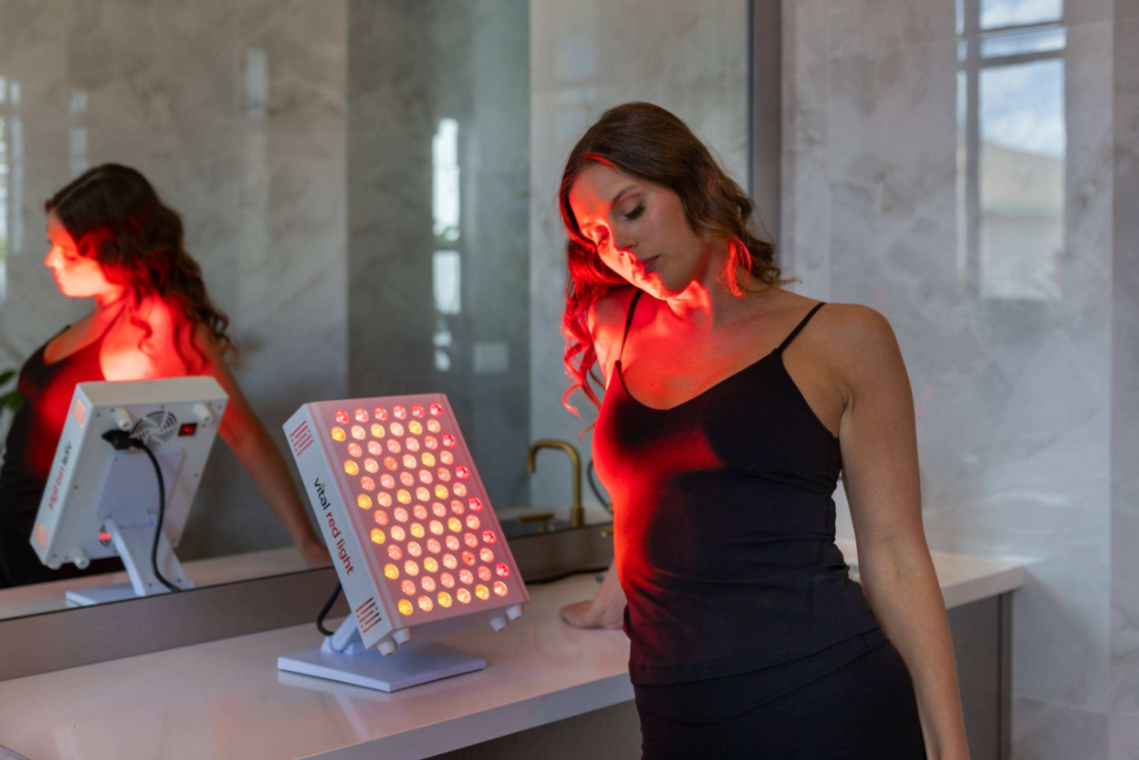
Does Red Light Therapy Give You Vitamin D? Here's What the Research Actually Shows

As the days get shorter, a lot of red light therapy users start wondering if their panel is quietly doing double duty as a vitamin D source. It's a reasonable question. Both come from light. Both get filed under "skin health." Both feel like something your body needs more of in the winter.
The honest answer is no, red light therapy does not produce vitamin D. But that's not the disappointing dead end it sounds like, because the research on red light therapy and vitamin D turns up something more interesting than a simple yes or no.
The short answer: red light therapy doesn't create vitamin D
Vitamin D synthesis happens through a very specific mechanism. Roughly 80% of the vitamin D your body makes on its own comes from ultraviolet B (UVB) radiation converting a compound called 7-dehydrocholesterol into pre-vitamin D3 in your skin's outer layer. That reaction depends on UVB wavelengths specifically, roughly 280 to 315 nanometers.
Red light therapy devices work in a completely different part of the light spectrum, generally 600 to 1,000+ nanometers. That's red and near-infrared light, and it simply doesn't carry the right energy to trigger the same chemical reaction. So if you're asking "does red light therapy give you vitamin D," the direct answer is no. Red light therapy doesn't produce vitamin D, and it isn't a substitute for sun exposure, supplementation, or diet when it comes to your vitamin D levels specifically.
That mix-up is understandable. UVB and red light both arrive to us through sunlight, both get grouped under "light therapy," and both get associated with skin health in a general sense. But they sit at opposite ends of the light spectrum and do genuinely different jobs in the body.

Where red light therapy actually intersects with vitamin D
Here's where it gets more interesting than a flat no. While red light therapy doesn't create vitamin D directly, there's emerging research on a related pathway: magnesium.
Magnesium is a required cofactor for activating vitamin D in your body. The enzymes responsible for converting vitamin D into its usable form, hepatic 25-hydroxylase and renal 1α-hydroxylase, are both magnesium-dependent processes. Without enough magnesium, the vitamin D you do have on board can't be fully put to use.
A small study of 40 patients with diabetic peripheral neuropathy found something worth noting here. After photobiomodulation treatment, researchers observed a notable rise in both vitamin D and magnesium levels, without any magnesium supplementation involved. A separate trial looked at people with spinal cord injuries and osteoporosis, and found that serum vitamin D levels increased significantly after a course of photobiomodulation treatment, although bone density itself didn't shift in that study.
Worth being upfront about the limits here. Both of these studies looked at specific patient populations dealing with existing health conditions, not healthy adults using a red light panel at home. They point to a mechanism worth watching, not a guarantee of what will happen in your own body. Read them as an interesting research thread, not a reason to skip your vitamin D check at your next physical.
The bigger reframe: maybe it was never only about vitamin D
There's a broader idea in the research that's worth sitting with. For years, sun exposure's health benefits have largely been credited to the vitamin D it produces. But a research review points out that despite strong associations between sun exposure, vitamin D levels, and lower rates of chronic disease, a substantial body of randomized controlled trials and Mendelian randomization studies has failed to confirm major health benefits from vitamin D supplementation itself.
That gap raises a real question. If supplementing vitamin D alone doesn't reliably replicate what sunlight does for us, what else is sunlight doing? The same review points to red and near-infrared light, both naturally present in sunlight, as a possible piece of that answer. One study built into that research ran across both summer and winter and found consistent improvements from light exposure, specifically better mood and less drowsiness, independent of vitamin D status.
That's arguably the most useful finding in this entire conversation for anyone asking whether red light therapy helps with winter blues. It's not about vitamin D at all. It's a separate mechanism working through mitochondrial function rather than vitamin D synthesis, and it holds up across seasons.
What this means for your winter routine
Red light therapy isn't a vitamin D substitute, and it shouldn't be treated like one. If your levels are low, that's a conversation for sun exposure, food sources, or supplementation, guided by an actual blood test rather than guesswork.
But the mood and energy support angle is real, and it's a separate benefit worth building into a winter routine on its own terms. Pairing sensible vitamin D management with consistent red light sessions covers two different mechanisms instead of expecting one tool to do both jobs.

Quick answers
Does red light therapy give you vitamin D? No. Vitamin D synthesis requires UVB light, a different part of the spectrum than the red and near-infrared wavelengths red light therapy uses.
Does red light therapy help with vitamin D deficiency? Not directly. Some research shows a connection through magnesium, which your body needs to activate vitamin D, but this has mostly been studied in specific patient populations, not as a general deficiency treatment.
Can you get vitamin D from a red light panel? No. Only UVB light, generally from sun exposure or a dedicated UVB device, triggers vitamin D synthesis in skin.
Does red light therapy help with winter blues? Research suggests light exposure in the red and near-infrared range may support mood and reduce drowsiness across seasons, through a mechanism separate from vitamin D.
Share